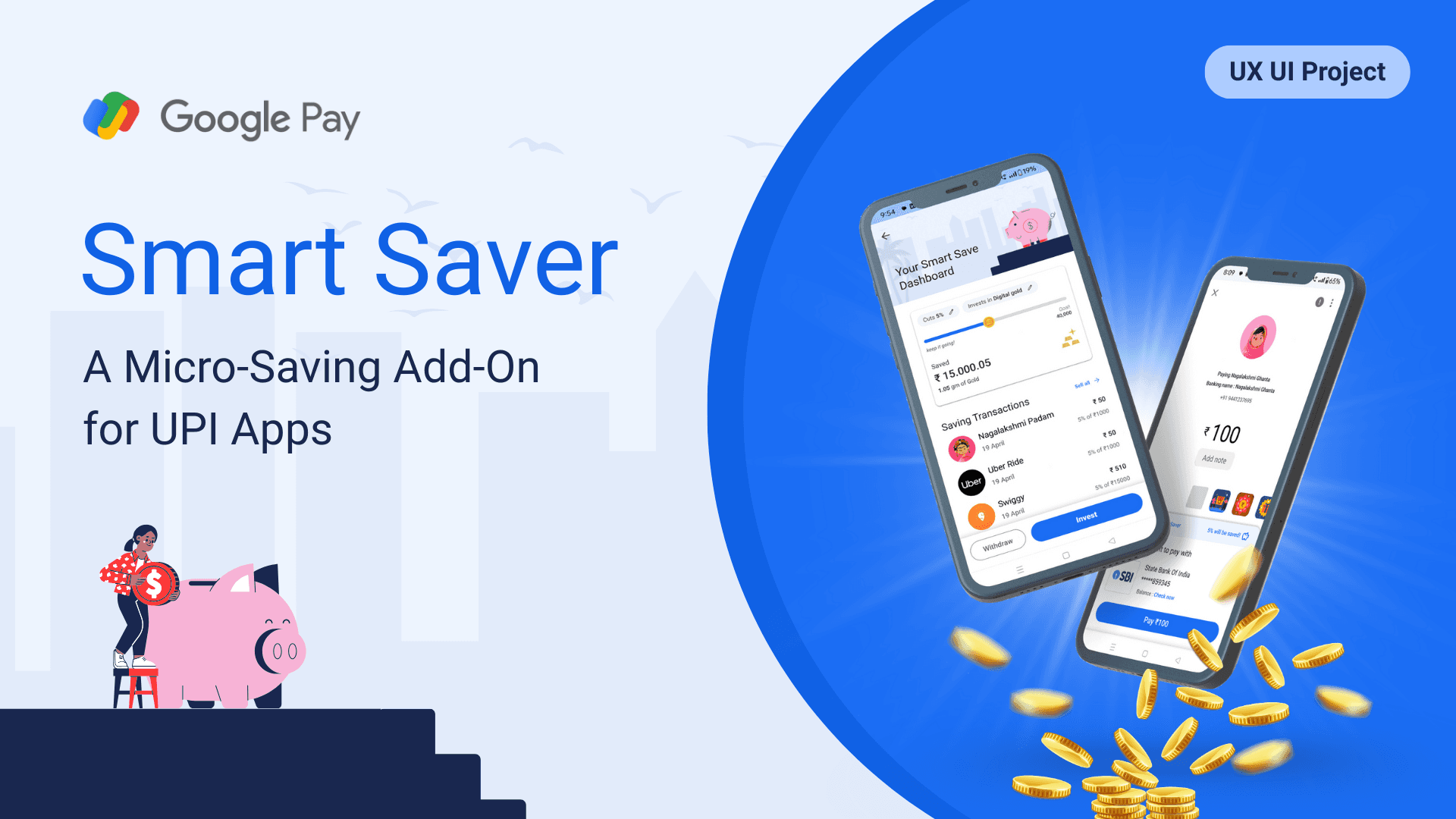
1. The Spark: Why This Exists
1. The Spark: Why This Exists
Most of us want to save money, but let's face it, adulting is hard. Setting up new apps, navigating complex investment jargon, and remembering to save every month? Meh.
Yet, we use GPay or PhonePe for almost everything. So... what if saving just happened automatically every time we made a payment?
Most of us want to save money, but let's face it, adulting is hard. Setting up new apps, navigating complex investment jargon, and remembering to save every month? Meh.
Yet, we use GPay or PhonePe for almost everything. So... what if saving just happened automatically every time we made a payment?

Assumption-Backed Research Data
Assumption-Backed Research Data
UPI Is Everywhere
UPI Is Everywhere
Over 10 billion UPI transactions happen every month in India. Driven largely by users aged 18–35. (NPCI, 2023)
Over 10 billion UPI transactions happen every month in India. Driven largely by users aged 18–35. (NPCI, 2023)
Gen Z Struggles to Save
Gen Z Struggles to Save
60% of Gen Z in India save less than ₹500/month.
60% of Gen Z in India save less than ₹500/month.
1 in 3 feel overwhelmed by the idea of managing savings manually. (MoneyControl, 2023)
1 in 3 feel overwhelmed by the idea of managing savings manually. (MoneyControl, 2023)
The Demand for Easy, Automated Saving
The Demand for Easy, Automated Saving
Apps like Jar, Fi, and Jupiter have seen 3× growth among 18–30 year olds. (Moloco Case Study)
Apps like Jar, Fi, and Jupiter have seen 3× growth among 18–30 year olds. (Moloco Case Study)
This signifies users crave simplicity in finance tools.
This signifies users crave simplicity in finance tools.
The Financial Literacy Gap
The Financial Literacy Gap
Only 27% of Indians are considered financially literate, and just 16.7% of students grasp basic money management. (OECD, Business Standard).
Only 27% of Indians are considered financially literate, and just 16.7% of students grasp basic money management. (OECD, Business Standard).

The Goal
The Goal
"How might we enable effortless encourage micro-savings for Gen Z and millennials without adding friction to their existing payment behaviour?"
"How might we enable effortless encourage micro-savings for Gen Z and millennials without adding friction to their existing payment behaviour?"
4. Candid Conversations That Sparked the Idea
4. Candid Conversations That Sparked the Idea
4. Candid Conversations That Sparked the Idea
Overwhelmed by Complexity
”I want to save and invest, but honestly the stock market stuff overwhelms me."
— Meenal, 25, UX Designer
Insight: Many users are interested in investing but feel anxious or ill-equipped to navigate complex financial tools.
Friction Blocks Action
"I want to save, but apps like Jar or Groww feel like a big effort. I wish saving was more passive."
— Aditya, 25, Product Manager
Insight: Users value saving but find the onboarding and app-switching experience tedious. Simplicity and integration matter.
Low Visibility = Low Noticing
"Out of sight, out of mind. I don’t notice small spending leaks."
— Aanya, 24, UX Designer
Insight: Micro-spends go unnoticed — but could be powerful saving moments if captured and made visible.
Habitual Use
"I use GPay all the time, even to pay for pani puri. If I saved every time I paid... I’d be rich!"
— Sanika, 22, Student
Insight: UPI platforms like GPay are embedded in daily routines — making them perfect gateways for micro-saving features.
Trust Matters More Than Risk Appetite
"Stock market is intimidating. If GPay could help me save in a way I understand, I’d try it."
— Pratik, 27, Software Engineer
Insight: Users may shy away from volatile investments — but they’re open to trying if it’s via a trusted, familiar app.
Overwhelmed by Complexity
”I want to save and invest, but honestly the stock market stuff overwhelms me."
— Meenal, 25, UX Designer
Insight: Many users are interested in investing but feel anxious or ill-equipped to navigate complex financial tools.
Friction Blocks Action
"I want to save, but apps like Jar or Groww feel like a big effort. I wish saving was more passive."
— Aditya, 25, Product Manager
Insight: Users value saving but find the onboarding and app-switching experience tedious. Simplicity and integration matter.
Low Visibility = Low Noticing
"Out of sight, out of mind. I don’t notice small spending leaks."
— Aanya, 24, UX Designer
Insight: Micro-spends go unnoticed — but could be powerful saving moments if captured and made visible.
Habitual Use
"I use GPay all the time, even to pay for pani puri. If I saved every time I paid... I’d be rich!"
— Sanika, 22, Student
Insight: UPI platforms like GPay are embedded in daily routines — making them perfect gateways for micro-saving features.
Trust Matters More Than Risk Appetite
"Stock market is intimidating. If GPay could help me save in a way I understand, I’d try it."
— Pratik, 27, Software Engineer
Insight: Users may shy away from volatile investments — but they’re open to trying if it’s via a trusted, familiar app.

Ideation Journey
Ideation Journey
Exploring How Smart Saving Could Work on GPay, To define the right saving behaviour, I started with key How Might We questions:
Exploring How Smart Saving Could Work on GPay, To define the right saving behaviour, I started with key How Might We questions:
How can I help people save money without even trying, or downloading yet another app?
What if saving money was as easy as checking a box after your next GPay transaction?
Can I make saving so simple, you forget you’re even doing it?
How do I turn everyday GPay payments into guilt-free little savings wins?
How can I help people save money without even trying, or downloading yet another app?
What if saving money was as easy as checking a box after your next GPay transaction?
Can I make saving so simple, you forget you’re even doing it?
How do I turn everyday GPay payments into guilt-free little savings wins?

Ideas Explored 💡
Ideas Explored 💡
Daily/Weekly Auto-Saving Rules
User selects a fixed amount (₹50/week or ₹10/day).
❌ Felt like a chore. Lacks flexibility. Easy to forget or disable.
Save Your Cash back
Redirect cash back into a wallet or micro-investment.
✅ Effortless, ❌ but cash backs are small + unpredictable = low motivation.
Spare Change Round-ups
Spend ₹97, save the leftover ₹3 into savings.
✅ Good concept, ❌ but depends on random math, user will not have fixed clarity
Goal-Based Savings Tracker
Users set goals like “New phone ₹10,000 by Oct,” and save manually.
✅ Strong motivation, ❌ needs efforts to setup, and doesn’t work passively.
Gamified Savings Challenges
Save ₹50 every day for 30 days = unlock rewards.
✅ Fun for some, ❌ but can feel forced and gimmick. Doesn’t suit all personalities.
Final Pick:
Smart Save with % Cut Per Transaction (2%, 5%, 10%)
How it works:
Users sign up once and choose a saving percentage (2%, 5%, or 10%).
From then on, every time they pay via GPay, that % is automatically saved.
Want to skip it? Just uncheck the Smart Save box before you enter your UPI PIN.
✅ Why this works:
Effortless yet customizable: One-time setup, works in the background.
Builds into as a habit.
Gives control, not pressure, Toggle it off any time before payment.
Feels light and non-intrusive. Seemless integration, low-commitment, high return.
Builds trust and delight. Users see small wins growing over time.
This solution checked all the boxes: low effort, high familiarity, emotionally rewarding, and frictionless.
Daily/Weekly Auto-Saving Rules
User selects a fixed amount (₹50/week or ₹10/day).
❌ Felt like a chore. Lacks flexibility. Easy to forget or disable.
Save Your Cash back
Redirect cash back into a wallet or micro-investment.
✅ Effortless, ❌ but cash backs are small + unpredictable = low motivation.
Spare Change Round-ups
Spend ₹97, save the leftover ₹3 into savings.
✅ Good concept, ❌ but depends on random math, user will not have fixed clarity
Goal-Based Savings Tracker
Users set goals like “New phone ₹10,000 by Oct,” and save manually.
✅ Strong motivation, ❌ needs efforts to setup, and doesn’t work passively.
Gamified Savings Challenges
Save ₹50 every day for 30 days = unlock rewards.
✅ Fun for some, ❌ but can feel forced and gimmick. Doesn’t suit all personalities.
Final Pick:
Smart Save with % Cut Per Transaction (2%, 5%, 10%)
How it works:
Users sign up once and choose a saving percentage (2%, 5%, or 10%).
From then on, every time they pay via GPay, that % is automatically saved.
Want to skip it? Just uncheck the Smart Save box before you enter your UPI PIN.
✅ Why this works:
Effortless yet customizable: One-time setup, works in the background.
Builds into as a habit.
Gives control, not pressure, Toggle it off any time before payment.
Feels light and non-intrusive. Seemless integration, low-commitment, high return.
Builds trust and delight. Users see small wins growing over time.
This solution checked all the boxes: low effort, high familiarity, emotionally rewarding, and frictionless.

What’s in it for GPay?
What’s in it for GPay?
Increased Engagement Time
Increased Engagement Time
Micro-savings add emotional value to every transaction. Users revisit the app not just to pay, but to track, celebrate, and grow their savings.
Micro-savings add emotional value to every transaction. Users revisit the app not just to pay, but to track, celebrate, and grow their savings.
Strengthens Trust & Stickiness
Strengthens Trust & Stickiness
By helping users build healthy saving habits, GPay becomes more than a utility. It becomes a financial ally users won’t switch from.
By helping users build healthy saving habits, GPay becomes more than a utility. It becomes a financial ally users won’t switch from.
Boosts Monthly Active Users (MAUs)
Boosts Monthly Active Users (MAUs)
With the "Smart Save" feature nudging repeat visits, you drive habit loops that increase app retention and daily usage.
With the "Smart Save" feature nudging repeat visits, you drive habit loops that increase app retention and daily usage.
Differentiation from Competitors
Differentiation from Competitors
While other UPI apps focus only on payments, GPay integrates micro-finance with simplicity. A unique value prop in a saturated market.
While other UPI apps focus only on payments, GPay integrates micro-finance with simplicity. A unique value prop in a saturated market.
Solution Overview
Solution Overview
Onboarding: Set your saving % (2%, 5%, or 10%) and preferred investment type (Gold, Equity, Wallet).
Payment Flow : Each time you make a GPay transaction, the selected % is automatically saved.
You can toggle it OFF during payment, right before UPI PIN entry.
Smart Save Dashboard : Track your total savings, investment performance, and progress toward optional goals.
Withdraw or Invest More : Withdraw instantly or boost your savings manually anytime.
Onboarding: Set your saving % (2%, 5%, or 10%) and preferred investment type (Gold, Equity, Wallet).
Payment Flow : Each time you make a GPay transaction, the selected % is automatically saved.
You can toggle it OFF during payment, right before UPI PIN entry.
Smart Save Dashboard : Track your total savings, investment performance, and progress toward optional goals.
Withdraw or Invest More : Withdraw instantly or boost your savings manually anytime.
Where it fits in? - Information Architecture
Where it fits in? - Information Architecture
Onboarding : Set your saving % (2%, 5%, or 10%) and preferred investment type (Gold, Equity, Wallet).
Payment Flow : Each time you make a GPay transaction, the selected % is automatically saved.
You can toggle it OFF during payment, right before UPI PIN entry.
Smart Save Dashboard : Track your total savings, investment performance, and progress toward optional goals.
Withdraw or Invest More : Withdraw instantly or boost your savings manually anytime.
Onboarding : Set your saving % (2%, 5%, or 10%) and preferred investment type (Gold, Equity, Wallet).
Payment Flow : Each time you make a GPay transaction, the selected % is automatically saved.
You can toggle it OFF during payment, right before UPI PIN entry.
Smart Save Dashboard : Track your total savings, investment performance, and progress toward optional goals.
Withdraw or Invest More : Withdraw instantly or boost your savings manually anytime.
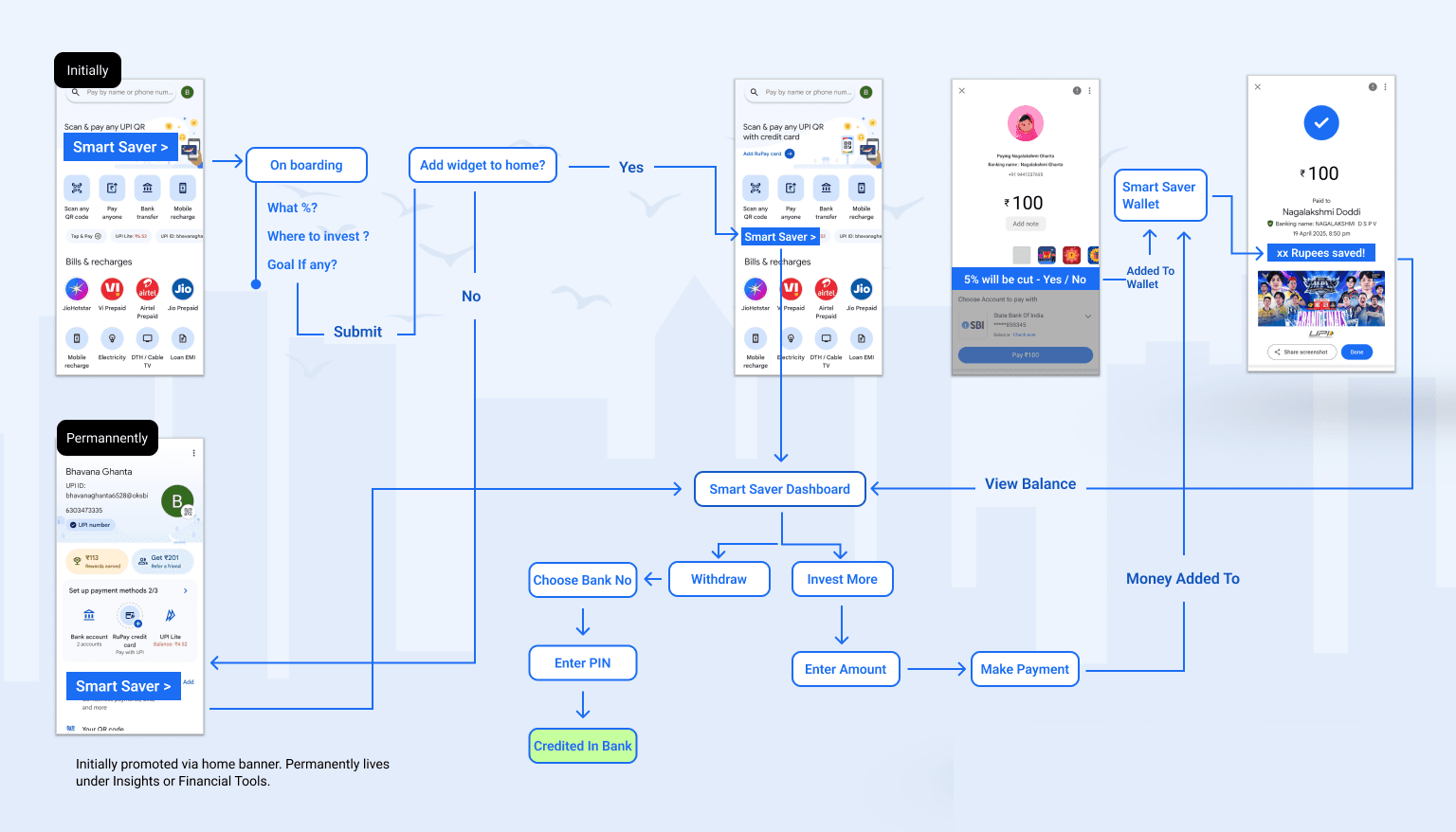
A brief information architecture diagram
. What goes where ? ( Wire framing )
. What goes where ? ( Wire framing )
I created low-fidelity wireframes to quickly visualize the structure and key flows of the feature.
This helped me map out the user journey, placement, and interactions before moving to high-fidelity designs.
I created low-fidelity wireframes to quickly visualize the structure and key flows of the feature.
This helped me map out the user journey, placement, and interactions before moving to high-fidelity designs.
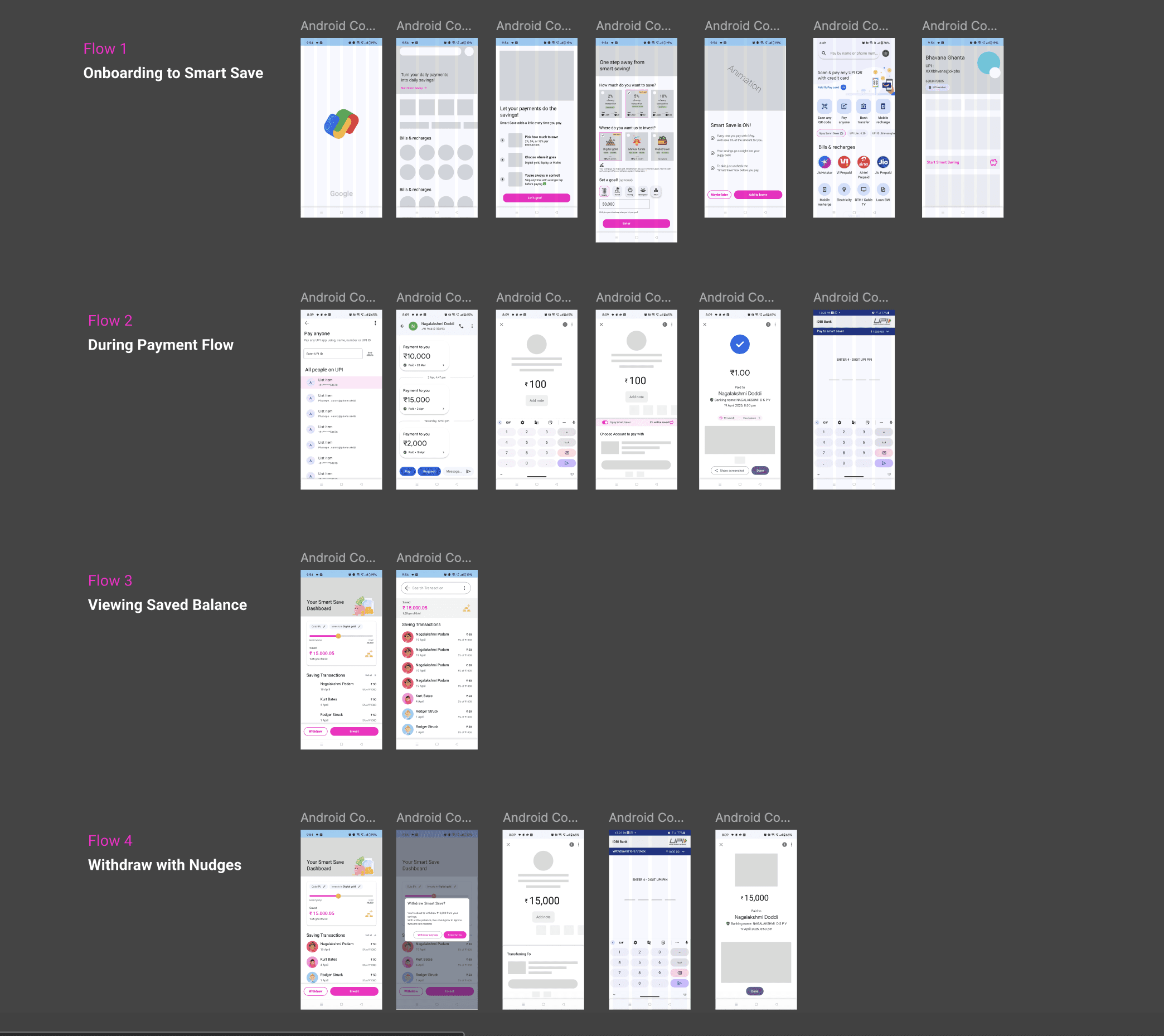
High level wire framing, colour the main highlights in pink.

Flow I : Onboarding to Smart Save!
Flow I : Onboarding to Smart Save!
Flow
Prompt users with “Start Smart Saving?”
Let them choose a percentage (2%, 5%, 10%)
Set and forget—works silently in the background
Pros
Personalisation increases ownership & stickiness
Gives control and flexibility (not one-size-fits-all)
Seamless after the setup, low effort
Features Notes
default “Recommended” setting (e.g., 5%) for faster onboarding
Visual examples like: “Pay ₹500, we’ll save ₹25.”
Assumptions
Users trust Google Pay enough to allow auto-deductions
Users want to customize how much they save
Too much effort in onboarding might lead to drop-offs
Flow
Prompt users with “Start Smart Saving?”
Let them choose a percentage (2%, 5%, 10%)
Set and forget—works silently in the background
Pros
Personalisation increases ownership & stickiness
Gives control and flexibility (not one-size-fits-all)
Seamless after the setup, low effort
Features Notes
default “Recommended” setting (e.g., 5%) for faster onboarding
Visual examples like: “Pay ₹500, we’ll save ₹25.”
Assumptions
Users trust Google Pay enough to allow auto-deductions
Users want to customize how much they save
Too much effort in onboarding might lead to drop-offs

Flow II : During Payment Flow
Flow II : During Payment Flow
Flow
Every time a user pays, 5% gets saved
Users can switch this off from the payment screen (toggle)
Pros
Subtle nudge at high-intent moment
Builds habit through repetition
Offers control without going into settings
Features Notes
fun, tiny animation or icon (like a piggy bank filling)
Snack-bar messages - “₹25 saved! Tap to see more.”
Assumptions
Users will notice and understand the toggle
5% feels small enough to not hurt spending
Users want control at the moment of payment
Flow
Every time a user pays, 5% gets saved
Users can switch this off from the payment screen (toggle)
Pros
Subtle nudge at high-intent moment
Builds habit through repetition
Offers control without going into settings
Features Notes
fun, tiny animation or icon (like a piggy bank filling)
Snack-bar messages - “₹25 saved! Tap to see more.”
Assumptions
Users will notice and understand the toggle
5% feels small enough to not hurt spending
Users want control at the moment of payment

Flow III : Viewing Dashboard
Flow III : Viewing Dashboard
Flow
The user can view the payment till data, amount invested and the transactions
This dashboard can be navigated from home screen or under the profile icon page.
Pros
Emotional reinforcement builds habit
Encourages revisiting the feature
Helps users internalise “I am a saver!”
Features Notes
Use progress rings or “jar filling up” animations
User can view the goals they have set.
Badge levels fro user like “Tiny Saver…
Assumptions
Visual celebration improves habit stickiness
Users love gamification and progress
Flow
The user can view the payment till data, amount invested and the transactions
This dashboard can be navigated from home screen or under the profile icon page.
Pros
Emotional reinforcement builds habit
Encourages revisiting the feature
Helps users internalise “I am a saver!”
Features Notes
Use progress rings or “jar filling up” animations
User can view the goals they have set.
Badge levels fro user like “Tiny Saver…
Assumptions
Visual celebration improves habit stickiness
Users love gamification and progress

Flow IV : Withdraw And Invest With Nudges
Flow IV : Withdraw And Invest With Nudges
Flow
Users can withdraw and Invest at any time.
The app should encourage them to stay longer.
Pros
Flexibility = trust
Nudges can delay unnecessary withdrawals
Keeps savings feel like your money, not “locked away”
Features Notes
popup msgs like: “Withdraw ₹500 now or leave it until xxx to reach ₹XXX?”
Offer “Withdraw partially” as primary actions.
Assumptions
People withdraw impulsively unless nudged
Users may not know the long-term benefit of keeping money saved
Flow
Users can withdraw and Invest at any time.
The app should encourage them to stay longer.
Pros
Flexibility = trust
Nudges can delay unnecessary withdrawals
Keeps savings feel like your money, not “locked away”
Features Notes
popup msgs like: “Withdraw ₹500 now or leave it until xxx to reach ₹XXX?”
Offer “Withdraw partially” as primary actions.
Assumptions
People withdraw impulsively unless nudged
Users may not know the long-term benefit of keeping money saved

Did You Notice These Little Visual Joys?
Did You Notice These Little Visual Joys?
Smart Save isn't just functional, it should be delightful.
To make the experience feel more approachable and intuitive, I crafted custom illustrations like the cheerful Piggy Bank, expressive coin animations, and playful goal-setting icons.
These visuals not only guide users through the journey, but also celebrate every small win, turning everyday payments into something worth smiling about.
Because saving money should feel just as rewarding as spending !
Smart Save isn't just functional, it should be delightful.
To make the experience feel more approachable and intuitive, I crafted custom illustrations like the cheerful Piggy Bank, expressive coin animations, and playful goal-setting icons.
These visuals not only guide users through the journey, but also celebrate every small win, turning everyday payments into something worth smiling about.
Because saving money should feel just as rewarding as spending !


That’s a wrap!
That’s a wrap!
Thanks for scrolling through, would love to hear your thoughts, feedback, or even just a Hi !
Thanks for scrolling through, would love to hear your thoughts, feedback, or even just a Hi !